Dark States
Jesse Burke | Bill Finger | Stephen Hilyard
November 25 to December 31, 2024
This group show featured the work of three artists, each working with the themes of memory, artifice, and identity in the form of photographs which evoke an underlying instability.
Jesse Burke’s photographs and installations are an autobiographically driven exploration into the psychology of masculine identity. He is drawn to moments where a rupture or wound is physically, emotionally, or metaphorically inflicted. There is a presence of vulnerability and sensitivity in his work that acts as a force against the mythology or male dominance and power. Jesse lives in Rhode Island.
Bill Finger’s work deals with paramnesia: the distortion of memory in which fantasy and objective experience are confused. Working also with autobiography by using his childhood as a touchstone, Bill recreates places from his past in miniature. These miniatures serve as a stand in for his memories that he can photograph and then dismantle. By presenting a limited view, his photographs, like memories, provide only glimpses into the past and call on the viewer to question both.
Stephen Hilyard’s work in digital photography, video, and installation has led him to look closely at the history of the culture that made him what he is. He recently has become interested in the idea of lying, in the subversion of various types of information that we are accustomed to trust. In recent image-based piece, the “King Wave” series, the reliability of photographic knowledge is been brought into question by digital manipulation of the images. It is the ability of the computer to lie very convincingly that has made him interested in adding it to the list of tools that he uses to create work. Ultimately, his work is designed to remind the viewer of artifice: the work is attempting to present something of a profound nature, but that it is failing because of its connections to the concrete. In this the viewer recognizes her or his own condition.
.jpg)
Jesse Burke Nectar Imperial (Nils), Nectar Imperial (Carlo) (diptych), archival inkjet prints, 24 x 20 inches, each
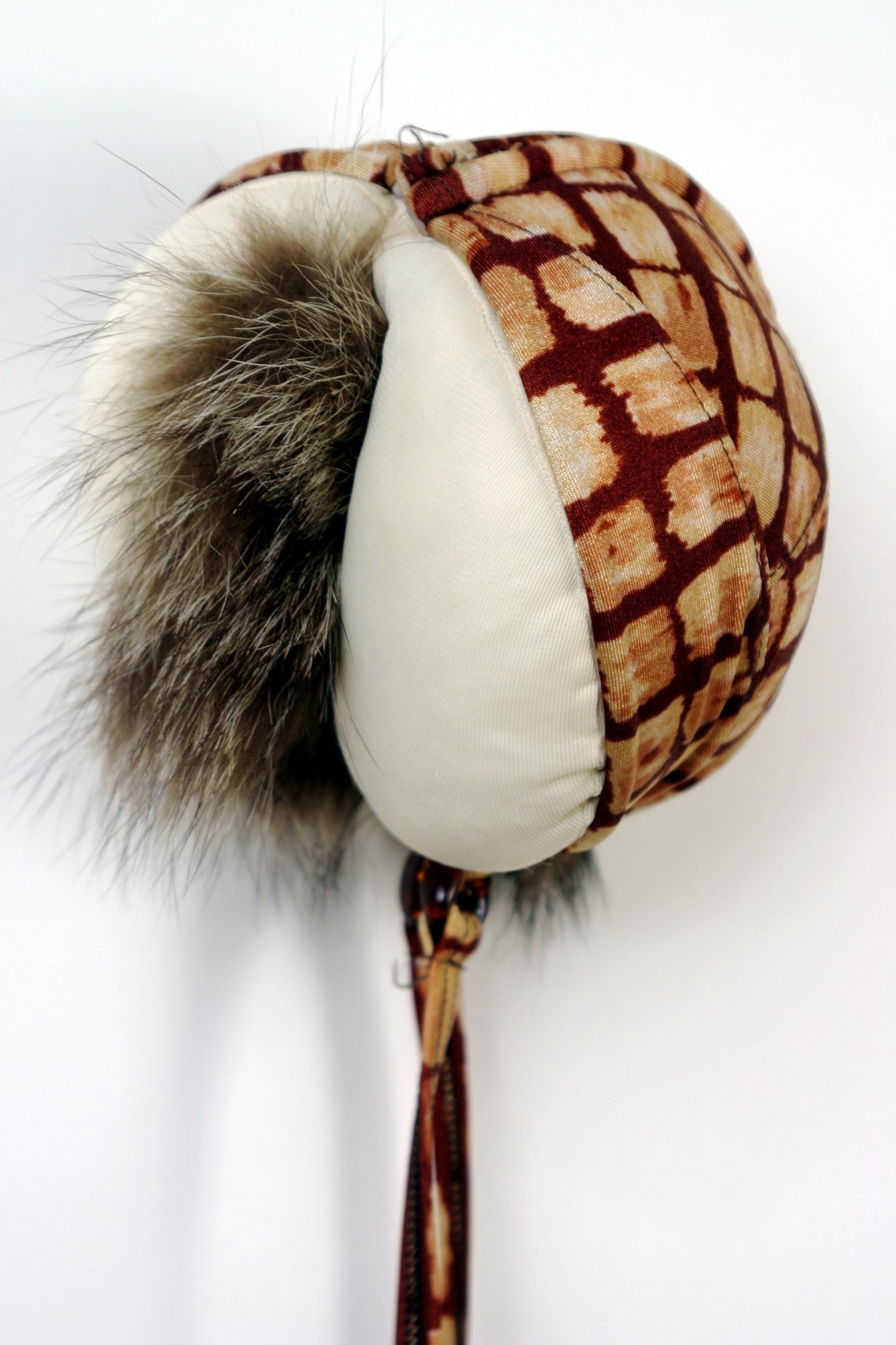
Jennifer McNeely Harriet, 2005, fabric, fake fur, 11 x 26 inches
Jennifer McNeely ". . . and another thing!"
October 13 to November 19, 2024
“I have always worked with a belief that a little of one’s character transfers into personal items. I collect nylons, hats, gloves, curlers and other symbols of 'properly restrained ladies' for my work. These items serve as both inspiration and measuring stick for me as an artist. Conceptually, I am interested in breakdown and repair, and the cultural situation and compulsions of women. The time women spend on repair and improvements is endless: on our physical appearance, on our relationships, and on the world around us. Because there is always something imperfect to focus on, the work is never complete. Maintenance becomes at once overwhelming and seemingly necessary. My subject matter has often been an exploration of contradictions: between hard and soft, the masculine and the feminine, the grotesque and the beautiful. The work of women both historically and currently mirrors these contradictions. In visual terms, these distinctions will eventually merge to create a new thing entirely. This exhibit represents a shift in my work. Prior to this, I focused on paying tribute too, or creating reverence for the object itself, or its role in context to my vision. With this work I hope to transcend the found object and instead create a textile woven with the lives of the women that these items inhabited. This work is bigger than the sum of its parts and has moved ahead. I can almost hear its liberated cry, ‘. . . and another thing!’ ”
Susan Robb recording field level five
September 1 to October 8, 2024
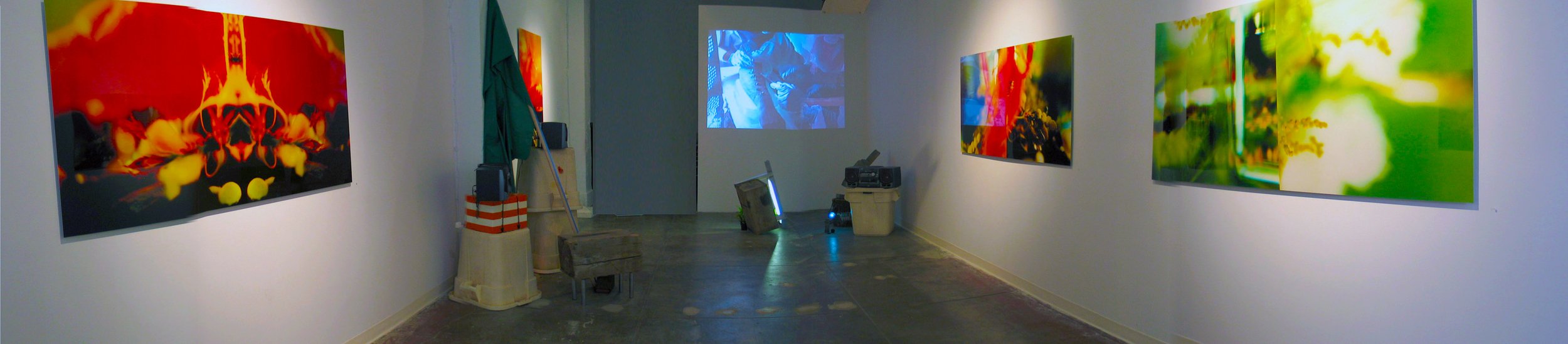
Susan Robb installation view
The work in this exhibition looked at the loss of security and the fall into dystopia where one is isolated from nature open to being battered and bruised by culture. This series of work included video in which nature is viewed as an isolated event; sampled sound pieces made from recordings of the 2004 Whitney Biennial, which abstract the very thing that should clarify; and an installation ominously called The Wall. Also included were large-scale photographs generated from The Wall that are lush landscapes even while they throb and pulsate like bruised skin. It’s not all as bleak as it could be, however; Susan Robb’s wry humor points the viewer towards a means of escape and personal autonomy.
Susan Robb was a recipient of a Pollack-Krasner Award as well as a City of Seattle CityArts Projects Grant. Her work has been included in Gene(sis): Contemporary Art Explores Human Genomics, a exhibition that travelled nationally and was organized by the Henry Art Gallery, as well as in exhibitions in Berlin, Tokyo, and Sweden and the Pacific Northwest. She was the recipient of The Stranger’s 2003 Genius Award in the visual artist category.
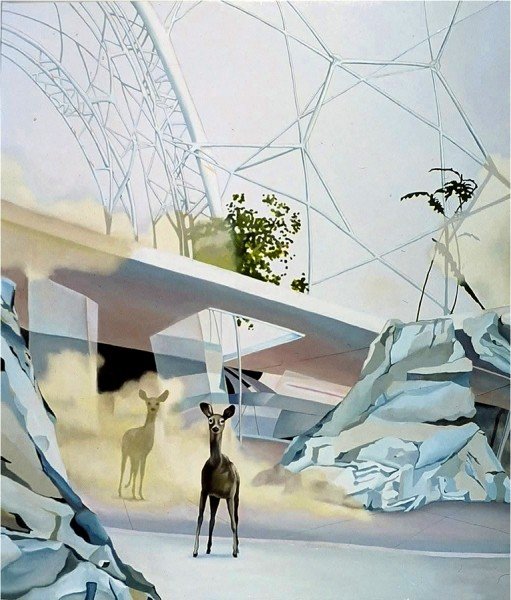
Patte Loper Interior with Fake Rocks, 2005, oil on canvas on panel, 28 x 24 inches
5 Painters
Jaq Chartier | James Gudat | Patte Loper | Daniel Rushton | Kim Squaglia
June 23 to July 30, 2024
REVIEW Seattle Weekly (July 13, 2005–no longer online)
New paintings by Jaq Chartier (Seattle), James Gudat (Portland), Patte Loper (New York), Daniel Rushton (New York), and Kim Squaglia (Sacramento). In a time when installation art, new media, and large photography hold sway, artists continue to find inspiration and challenges in painting. This exhibition features the work of five artists whose work addresses the relevance and practice of painting and transcends the conventions of "a painted surface." Large scale and intimate, the paintings in the exhibition dialog with one another compositionally and conceptually through surface and depth.
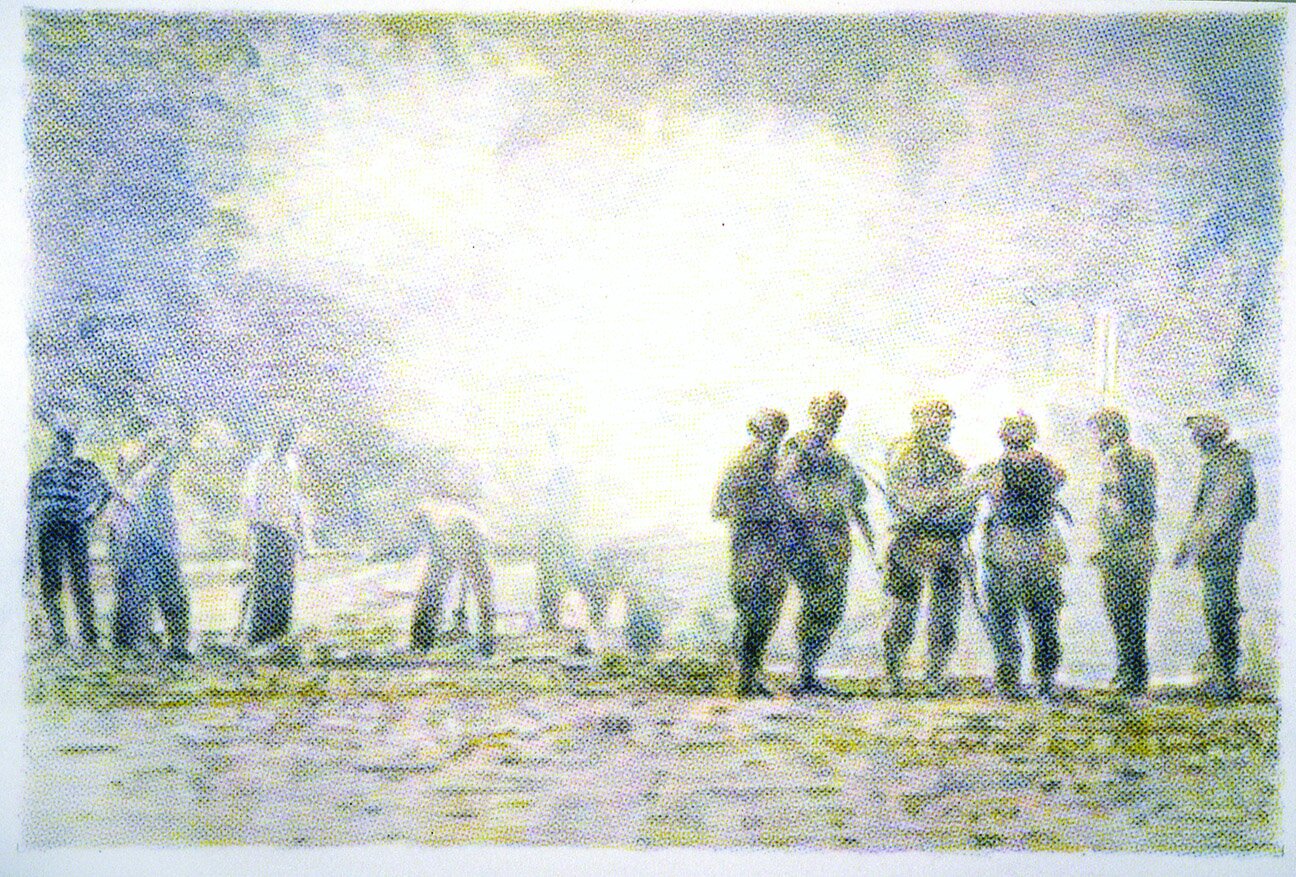
Stephen Andrews Night Manoeuvers 4, 2004, crayon rubbing on mylar, 20 x 28 inches (Private Collection)
Stephen Andrews
Between Before and After
May 12 to June 18, 2025
Since the 1980s, Stephen Andrews has worked to display what is hidden or repressed using drawing, etching, image transfer processes, and digital imaging techniques in order to produce work that deals with memory, identity, the body and the body politic. “... [T]he drawings re-create the look of four-color reproduction using a homemade separation technique. They are done as rubbings using window screening and crayons. The process softens the colors to a pastel palette, reminiscent of children’s book illustration. The contrast of the war imagery with the pastel color scheme brings to mind the moral tales of the Brothers Grimm. Gruesome lessons in a candy coating.”
The artist says the work in this exhibition bridges “a shift that has happened in the direction of the drawings. I really felt that looking at the horror of war for a couple of years was burning a hole in the center of me. The images of war are viral and indelible. Once they go in you can't get them out. The shift I am describing has been to find imagery that is more beatific, that is to say illustrative of some kind of transformative moment that may or may not be redemptive. ‘Going into the light’ may be a description of the moment of dying that we the living can understand or it may signal a coming out of a time of darkness.” The work ultimately is about hope.
Stephen Andrews’ work has been exhbitied in Canada, the U.S., Brazil, Scotland, France, India and Japan. He is represented in the collection of the National Gallery of Canada, as well as many private collections.
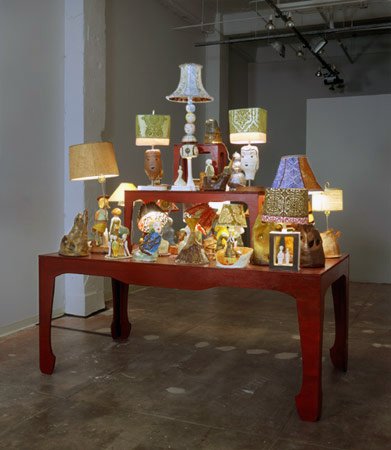
Saya Moriyasu, installation view
Saya Moriyasu Lamplight Lavish Gathering
March 31 to May 7, 2025
REVIEW The Stranger
REVIEW Seattle Weekly (April 21, 2005–no longer online)
In this exhibit Saya Moriyasu, presented a multitude of visual stories that are gatherings of form, function and nostalgia. She has used both traditional and contemporary angles in her choice of materials and their presentation to create a mountainous installation of handmade ceramic lamps. The stories that emerge result from what we bring as consumers well as the implied relationships due to their arrangement. The lamps can be seen as many short stories all acting out their own separate roles or a multi-chaptered novel reaching denouement with each dependent on one another for a singular ending.
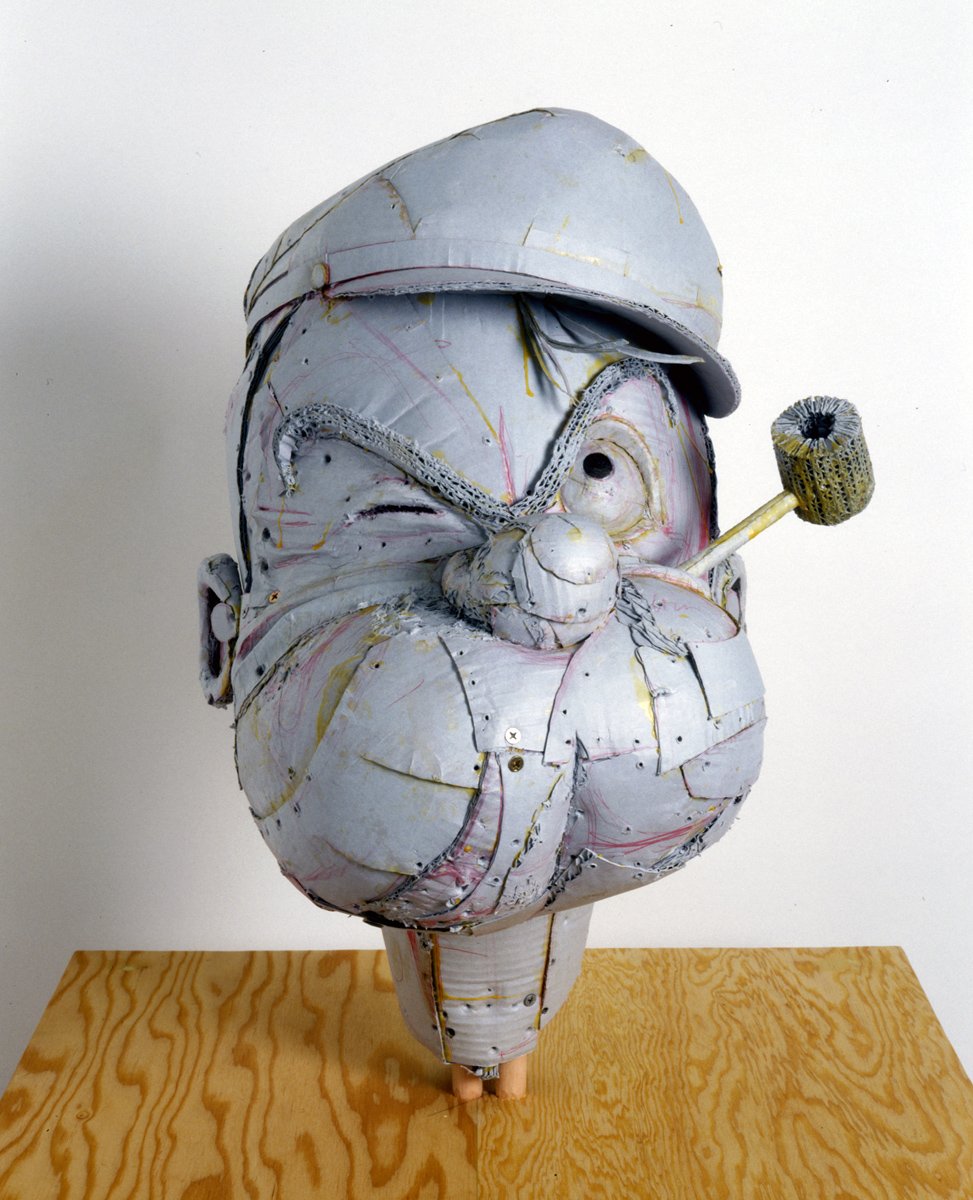
Scott Fife Popeye, 2005, archival cardboard, glue, screws, approximately 25 x 16 x 16 inches (Private Collection)
Scott Fife i am what i am
February 17 to March 26, 2025
REVIEW Seattle P.I.
REVIEW Art in America (September 2005–no longer online)
Imagine a meeting of Popeye, Frida Kahlo, Ludwig Mies van der Rohe, and Andy Warhol. Sound impossible? On the heels of his mid-career survey at the Tacoma Art Museum, Scott Fife has chosen to pare down to the essence of four distinct personalities for the more intimate setting of a gallery. For this exhibit, Scott has sculpted busts of Popeye, Kahlo, Mies van der Rohe, and Warhol, each icons in their own right and as a grouping a broad cultural representation of what it means to be "as you are" with all the attendant costs and benefits. Whether a public or a private persona, fictional or non-fictional, each individual struggled and succeeded in being an authentic self while living more than their “15 minutes of fame.” Sculpted larger than life in cool grey archival cardboard and assembled with screws and carpenter’s glue, Fife utilizes his architectural understanding of form and his aesthetic as a fine artist to build up a likeness that is undeniable yet not simply a objective representation. Scott captures a sense of strength as well as weakness in the individuality of each of these subjects.
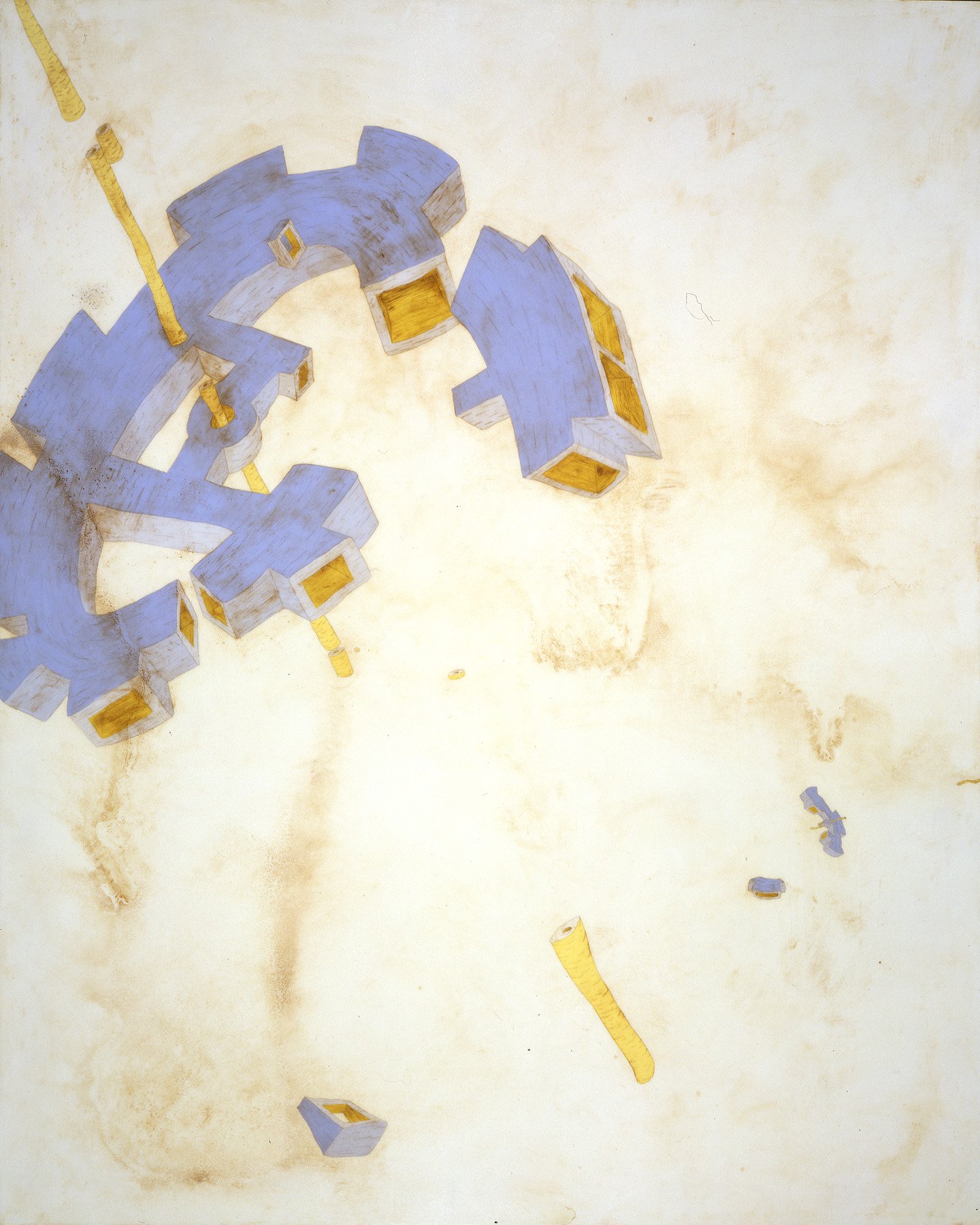
Blake Haygood Failure is Always an Option, 2004, acrylic on panel, 48 x 36 x 2.5 inches
Blake Haygood buck fever
January 6 to February 12, 2025
REVIEW Seattle P.I.
Comprised of works on panels which provide the viewer with a mysterious glimpse into an anxious, alternative universe, Blake Haygood’s work depicts an odd, shifting world in which partial and fragmented machines are simultaneously coming together while coming apart. The parts, which include shafts, blades, belts, cogs, and ropes may be sagging or might be sailing through a silent space without a horizon or sense of scale. While a feeling a melancholy pervades the work, a cautious optimism sneaks around the edges of the unknowable machines.