• MAY SPOTLIGHT •
Patte Loper
Quiet Country
•
These paintings and sculptures are part of a long-term project that began in 2019 to address urban biodiversity by envisioning fictitious public monuments to human and non-human interconnectedness. The objective of this project is to create a series of paintings and sculptures imagining memorials that decenter the human and engage in a radical reimagining of collective memory. This project is sited at All Faiths Cemetery in Queens, New York, where I am engaging in non-human participatory research methods to develop a framework of understanding with which to enter a shared space with non-human individuals and communities.
•
| Click images to enlarge |
Quiet Country
2021, installation view
Plant Communication Devices
2021 (in process), sticks and artificial flowers from All Faiths Cemetery, cement, potting soil, Sagebrush, and Wormwood plant from the Artemisia family with human DNA collected at burial site, pulp (from recycled cardboard with plaster leaf clippings, and catnip), doll eyeballs, papier-mâché, spray paint, insulation tape, wood, cardboard, grow light, 48h x 36w x 18d inches, NFS
•
The objects (reliquaries/devices/monuments) have begun to take on the aspect of guardians, looking over a small Artemisia collected from the cemetery, which likely is host to human DNA. Artemisia is a nurse plant, in the holobiome of the cemetery it creates a chemical environment that is beneficial to other plants, insects and animals. It is found on every continent, and in each place, indigenous stories assert that Artemisia wards off bad spirits.
•
I Try to Feel You by Being You
2021, green bedsheet, artificial flowers and tinsel from All Faiths Cemetery, hot glue, dimensions variable, NFS
•
I Try to Feel You by Being You
2021, 2 minute, 52 second video
This work owes a debt to New Materialists scholars whose research spans biology, philosophy, and feminist anthropology, particularly Donna Haraway and Anna Tsing. Their work has taught me much about human and multispecies entanglement. They question the centrality of ”Enlightenment Man”, the idea that places each human individual at the center of their own universe, creates us in the image of a disembodied eye centered in an imperial world of Cartesian geometry. It is this that separates us from the living world and allows us to see our surroundings as a resource to be consumed rather than a series of living, intertwined entities that support life on Earth. These devices, maps, and actions are part of a long slow process of unlearning what I have been taught about death, time, and being in the world.
Plant Communication Device
2021 (in process) , artificial flowers from All Faiths Cemetery, cement, water, stone from soil displaced by gravediggers, papier-mâché, spray paint, wood, cardboard, recycled jars, water, leeks, 18h x 12w x 12d inches, NFS
•
This project is in an early phase and I expect it will transform a great deal in coming months. This work has begun with close observation of native plant populations and nonhuman interactions. My hope is to encounter corporeal life and material phenomenon in a new way, but to also access an older way of knowing, but one that’s largely been forgotten, that recognizes that native growing plants organize their own holobiomes, regulate bacteria, insect, and animal populations. Many of these plants produce chemicals that are anti-inflammatory and anti-bacterial for humans as well as animals, birds, and other plants. Almost all of the local plants I’ve identified in the cemetery are edible for humans and contain beneficial medicinal properties. My ultimate goal is to learn from the plant’s capacity for decision making and movement, and to try to understand their connection to us.
•
Our Separation from Nature is Equal to Our Fear of Death
2021, graphite on paper, 12 x 9 inches, $475
The Thick Now
2021, graphite on paper, 12 x 9 inches, $475
Us and Everyone We Know in the Future
2021, graphite on paper, 9 x 12 inches, $475
Work from Quiet Country featured in our April Spotlight
Psychic Corporeal Map: We Are Coming
2021, oil paint and graphite on handstitched canvas, designed to be folded, 66 x 53 inches, $8,500
•
The paintings are large-scale, un-stretched canvasses designed to be folded like maps. These image-maps are of fictional memorial sites depicting land as body-territory, a feminist conceptual premise that looks at the body as a continuum of the land.
•
Psychic Corporeal Map: We Are Coming (detail)
•
Monuments of the cemetery have been reimagined as living, multi-individual organisms and inscriptions have been reinterpreted using historic language of resistance.
•
Psychic Corporeal Map: Your Day’s Coming
2021, oil paint and graphite on handstitched canvas, designed to be folded, 63.5 x 60 inches, $8,500
•
The paintings are created from irregular pieces of canvas hand-sewn together, evoking damage and repair as well as the imperfections of skin.
•
Psychic Corporeal Map: Your Day’s Coming (detail)
•
These works are loosely based on the same premise as Hieronymus Bosch’s Garden of Earthly Delights, showing us heaven, an earthly garden, and hell. This is a detail of the work that most closely correlates to hell.
•
Body Map of All Faiths Cemetery
2021, oil paint and graphite on handstitched canvas, designed to be folded, 27 x 27 inches, $2,500
•
All Faith’s provides a rich context in which to examine how, despite Robert Musil’s famous quote that “nothing is as invisible as a monument,” our current anxieties around monuments point to a profound discomfort with the visible indicators of our communal memory.
•
Plant Communication Devices
2021, sticks and artificial flowers from All Faiths Cemetery, cement, potting soil, Mugwort, Sagebrush, and Wormwood seeds with human DNA collected at burial site, stone from soil displaced by gravediggers, papier-mâché, spray paint, insulation tape, wood, cardboard, recycled jars, water, leeks, 32h x 36w x 12d inches, NFS
•
The sculptures are small, serve as maquettes for the monuments, and are built in the style of religious reliquaries or icons. Like reliquaries, they are designed to serve both as a celebration of, and repositories for, physical remains, however they will hold seeds and other biological specimens collected from the cemetery instead of the remnants of human individuals.
•
When thinking about plant chemical communication and underground mycelial networks, it is not out of the question to speculate about the possibility of human remains being present in the bodies of plants at the burial sites. Reflectors are designed to enhance the light environment for new plants, and this object is designed to greet new seedlings as they arise.
•
While waiting for the native plants to germinate, I am conducting communication experiments with leeks grown from food waste. These leeks appear to be responding to shape suggestions put forth by the sculptural arms of the device. I will continue to develop the device in response to the leeks’ growth.
•
Legs Land/Body Land/Face Land
2021, graphite on paper, 18 x 72 inches, $2,500
| Click each image to enlarge |
Pleated Land
2021, graphite on paper, 9 x 12 inches, $700
Study for Psychic Corporeal Map: We Are Coming
2020, graphite on paper, 18 x 24 inches, $1,500
Study for Psychic Corporeal Map: Quiet Country
2020, graphite on paper, 18 x 24 inches, $1,500
Study for Psychic Corporeal Map: Your Day’s Coming
2020, graphite on paper, 18 x 24 inches, $1,500
Study for Legs Land/Body Land/Face Land
2021, graphite on paper, 9 x 36 inches, $1,500
| Click each image to enlarge |
“A serious person faces those who came before to leave more quiet country”
- Donna Haraway quoting Deborah Bird Rose
“If there is a post-Anthropocene worth living in, those who live in it will need different stories, with no entity at the center of the stage.”
- Isabel Stengers
These psychic/corporeal maps and plant communication devices were created in response to nonhuman research practices I am undertaking at All Faiths Cemetery in Queens, NY. The cemetery runs through the center of Queens at its highest point, a vast and varied landscape that was long cared for by the Munsee Lenape and Canarsie tribes. Now connecting the neighborhoods of Glendale, Maspeth, and Middle Village, All Faiths sits on hilly land considered not suitable for farming by the working-class Christians who began using it as a burial ground in the 1800s. In its current existence, it is a loosely managed, abandoned-feeling space that has inadvertently become an urban sanctuary for native plants, insects, birds, and small mammals. There is a marked contrast between the vibrant proliferation of plant and animal life and the silent insistence of the memorials, the oldest of which date back to the founding of the cemetery, and the newest of which mark the recent graves of many pandemic dead. While these works reference historic Christian storytelling devices such as reliquaries and tapestries, they are interested in telling new stories that atone for the past and build new futures.
The psychic, corporeal maps of the cemetery are a way to think about the confluence of body and land, as well as the feminist idea of communal burial sites as “body territory,” where land becomes an extension of the human body. Meditation on time can be surreal in this space, and I think of these maps/landscapes/figures as showing All Faiths at multiple different times that exist concurrently and flow from one to another.
When thinking of human burial rituals, actor network theory, and chemical plant communication it is easy to consider the possible likelihood of human DNA being present in native plants at All Faiths. I have been collecting their seeds and am currently awaiting spring, at which point I can germinate and grow them to be my collaborators. “Devices for Thinking with Plants,” are proposals for new memorials that de-emphasize western culture’s aesthetic of violence and distanced visuality. The goal is to take us towards ongoingness, flourishing, and what feminist anthropologist Anna Tsing would describe as the “art of living well on a damaged planet.”
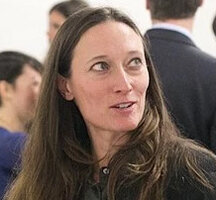
Patte Loper is an interdisciplinary artist based in painting who experiments with sculpture and video to explore a range of subject matter including feminist utopianism, new materialism, and the ecological imaginary. She was born in Colorado and grew up in Tallahassee, Florida, a subtropical college town where she first developed an appreciation for the ways nature and culture can overlap. She currently lives and works in New York City and Boston, MA, where she is on the faculty of the School of the Museum of Fine Arts at Tufts University. She has shown her work in numerous solo and group exhibitions nationally and internationally, including the Drawing Center (New York, NY), the Mattress Factory (Pittsburgh, PA), the Bronx Museum (Bronx, NY), the Licini Museum (Ascoli Piceno, Italy), the Tacoma Art Museum (Tacoma, WA), and Suyama Space (Seattle, WA). Her work has been reviewed in the Italian edition of Flash Art, Artnet, Time Out, Chicago, and the Boston Globe, and is in the collections of the Rene di Rosa Foundation, the Microsoft Corporation, and the Hirshhorn Museum. She has participated in residency fellowships at Yaddo, the Millay Colony, and Lower Manhattan Cultural Council, and was a participant in the Drawing Center's Open Sessions Program 2014-2016.